What Is Environmental Scanning?

March 9, 2026

 Table of content
 Share
Share
The global economy is rapidly changing, and small businesses can’t afford to operate in a slowing or dead space. To stay on the cutting edge, business owners need to be able to navigate the market with an eye on the future. To do that, many businesses employ environmental scanning.
Environmental scanning is the systematic monitoring of an organization’s internal and external environments to detect early signs of opportunities and threats. By gathering and analyzing information about the world around them, leaders can make proactive decisions rather than reactive ones, ensuring the business remains resilient and prepared for challenges.
The Three Levels of Environmental Scanning
To get a complete picture of the environment, a business must scan at three different distances. Think of it like a car: Looking at your own engine, the traffic around you, and the weather forecast for the area.
1. Internal Environment
This involves looking inward to evaluate the company’s health. Key elements include:
- Corporate culture
- Financial health
- Talent
- Operational efficiency.
The goal is to understand what the company is actually capable of achieving.
2. Task (Micro) Environment
This focuses on the “neighborhood” in which the company operates—the industry players that have a direct impact on daily operations. Key elements include:
- Customers
- Competitors
- Suppliers
- Labor markets.
The goal is to identify immediate competitive threats or shifts in buyer behavior.
3. General (Macro) Environment
This is the big picture view of broad societal forces that affect everyone, regardless of industry. Key elements include:
- Global economics
- Political shifts
- Technological breakthroughs.
The goal is to anticipate massive disruptions that could change the rules of the game entirely.
Core Frameworks and Techniques
Scanning can result in information overload if not organized. To be successful, most companies use structured frameworks to categorize their findings and remain focused.
PESTEL Analysis
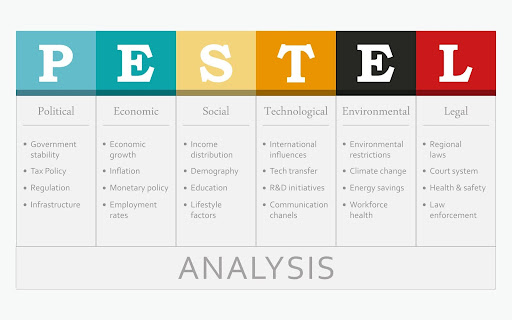
The PESTEL Analysis breaks down the world into six categories: Political, Economic, Social, Technological, Environmental, and Legal. This is typically seen as the gold standard for environmental scanning.
Source: Shutterstock
SWOT Analysis
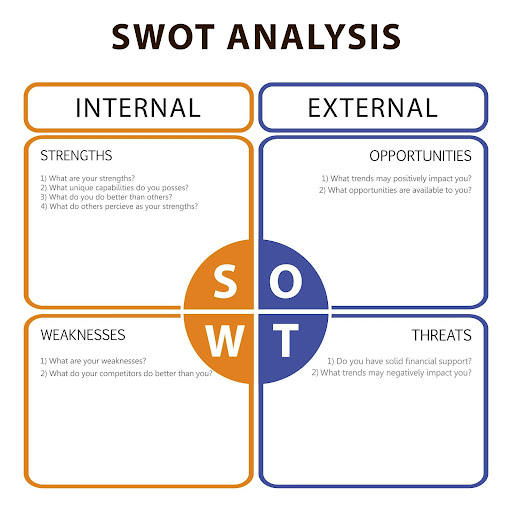
By merging internal scan data with external findings, companies can identify Strengths and Weaknesses (internal), and Opportunities and Threats (external).
Source: Shutterstock
Porter’s Five Forces
This less common framework helps scan the Task Environment by analyzing the intensity of competition, the power of suppliers, the power of buyers, the threat of new entrants, and the threat of substitute products.
How to Environmental Scan
Moving from raw data to a concrete business strategy can be a confusing challenge. Here’s the step-by-step process that companies typically take.
- Identify the scope: Decide which areas need the most focus. A tech company might prioritize Technology, while a manufacturing firm may prioritize Environmental and Legal buckets.
- Gather information: Collect data from diverse sources, including trade journals, social media trends, government whitepapers, and customer feedback. This should go beyond just market research.
- Analyze and interpret: Look for patterns. Is a specific customer complaint becoming a trend? Is a new law in one country likely to be adopted globally?
- Forecasting: How are these trends likely to change the business landscape in the next two years? In the next ten?
- Strategic integration: Categorize, organize, and present findings to all key stakeholders, whether it’s just a business partner or a board.
A successful environmental scan should have takeaway actions, whether it’s adjusting budgets, initiating research and development, or changing marketing plans.
Key Benefits of Environmental Scanning
There are several important benefits of environmental scanning for small businesses:
- Anticipating disruption: Catching shifts in consumer tech (like AI or blockchain) before they render your product obsolete.
- Competitive advantage: Discovering a gap in the market that competitors haven’t noticed yet.
- Risk mitigation: Developing contingency plans for potential economic downturns or supply chain failures.
- Resource allocation: Ensuring that limited capital is invested in areas where the wind is at your back rather than fighting against global trends.
Ultimately, the goal of environmental scanning is to help your business operate more efficiently and take advantage of more opportunities.
FAQs
Large-scale scans are often done annually during strategic planning, but environmental scanning should be a continuous process. Especially in fast-moving industries.
In large corporations, there may be a dedicated Strategic Planning or Business Intelligence team. In smaller businesses, it usually falls to the leadership team. In either case, it’s always wise to encourage frontline employees, like sales and customer support, to report what they’re hearing from customers and partners.
Market research is usually a targeted deep dive into a specific question. Environmental scanning is much broader; it looks at the entire ecosystem to understand the context in which the business exists.
Latest resources
Take a look at our news on Business Essentials