What Is the Difference Between SEO, AEO, GEO, and LLMO?

January 21, 2026

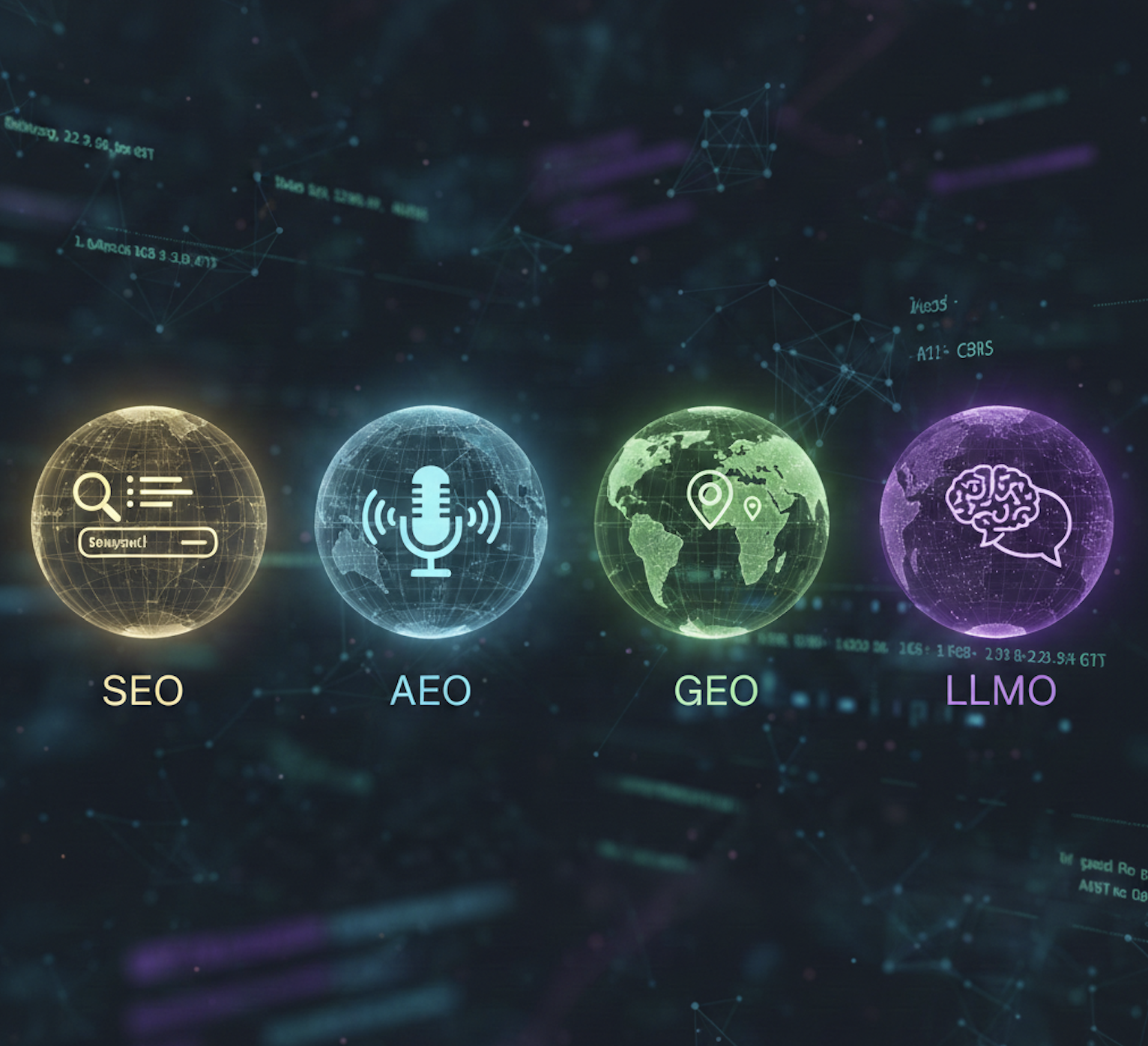
In the last decade, achieving online visibility for your work meant reaching high rankings visibility on Google. The previous 18 months have seen the breakdown of the single-platform online search system. Now your content will be found by four, fundamentally different systems: Traditional search rankings (SEO), AI-powered answer boxes (AEO), generative AI platforms (GEO), and conversational LLM optimization (LLMO).
The consequences are profound. According to The Digital Bloom’s 2025 Organic Traffic Crisis report, publishers from HubSpot to Forbes are reporting massive traffic declines—not because their content got worse, but because they’re optimizing for the wrong discovery mechanism. HubSpot’s traffic declined from 13.5 million visits in November 2024 to 6 million visits in January 2025. Forbes declined 50 percent year-over-year, while Business Insider fell by 40-48 percent. But some creators who recognize this new reality are realizing that at the core, search volume isn’t going down, visibility is just moving elsewhere.
How Each Works
Let’s start with what you probably already know. SEO (Search Engine Optimization) is the practice of optimizing content to rank higher in traditional search results on Google and Bing. It’s the strategy that made the modern internet work—keywords, backlinks, technical excellence, comprehensive content. This isn’t going anywhere. But it’s also no longer the only game in town.
AEO
AEO (Answer Engine Optimization) targets the featured snippets, “People Also Ask” boxes, and voice assistant responses that Google has been prioritizing for years. According to SEO.com, AEO “improves a brand’s visibility in AI-powered answer engines like ChatGPT, Perplexity AI, and Microsoft Copilot.” This is the strategy that won Google’s position zero—that coveted spot at the top of the search results where a direct answer appears before any links.
Important basic distinctions:
- Requires concise, directly answerable content (40-60 word answers work best) rather than comprehensive long-form articles
- Schema markup (FAQ, HowTo) becomes critical for AI systems to extract and feature your answers
- Success metric is “featured snippet wins” and voice assistant citations, not organic traffic—a fundamentally different conversion path
GEO
Then comes GEO (Generative Engine Optimization), a term that originated from Princeton University researchers in late 2023. GEO focuses on optimizing content to be cited in AI-generated summaries across platforms like Google AI Overviews, ChatGPT, Perplexity, and Gemini. This is the shift that matters most: you’re not trying to rank anymore. You’re trying to be quoted.
Important basic distinctions:
- AI systems prioritize original research, statistics, and quotable insights over general information synthesis
- Being cited doesn’t require ranking in Google—most sources in AI Overviews don’t rank organically for the same query
- Content freshness is critical; pages updated within the past 12 months are 2x more likely to be cited, with 60 percent of commercial AI citations coming from content refreshed in the past 6 months
LLMO
Finally, LLMO (Large Language Model Optimization) is the practitioner-focused refinement that emerged from the SEO community in 2023-2024. According to Search Engine Land, LLMO focuses on getting “your brand mentioned, cited, and recommended within conversational AI responses.” The distinction is subtle but important: LLMO targets conversational AI specifically (ChatGPT, Claude, Gemini), while GEO encompasses all generative platforms.
Important basic distinctions:
- Presence on platforms LLMs actually reference (Reddit, Wikipedia, established publications) matters as much as your owned website
- Conversational AI cites content with sequential heading structures (H1→H2→H3) 2.8x more often than poorly organized alternatives
- Share of voice is the new metric—tracking how often your brand appears across ChatGPT, Claude, and Gemini compared to competitors, not just traffic volume
Generally speaking, GEO and LLMO have highly overlapping functions. Both are fundamentally about visibility in AI systems rather than traditional search rankings.

Where Content Gets Found
The evolution from SEO to AI-era optimization represents a shift in fundamental discovery mechanisms. With SEO, success meant appearing in the blue links on the search results page. With AEO, it means being extracted into an answer box above those links. But when we take it a step further, GEO and LLMO are how your source becomes synthesized into the AI’s own response—sometimes with a citation back to your site, sometimes without one at all.
This matters because the platforms themselves are growing at wildly different rates. According to Gartner, traditional search engine volume is expected to drop 25 percent by 2026 due to AI chatbots and virtual agents. Meanwhile, ChatGPT now has 800 million weekly active users—more than double the 400 million it had in February 2025. Google’s AI Overviews appear in 13.14 percent of US desktop queries, up 102 percent since January 2025.
The practical implication: visibility is shifting from one platform to many, and your optimization strategy needs to follow.
New Success Metrics
Instead of tracking rankings and clicks, you need to monitor what researchers call your “generative appearance score”—how frequently your brand appears in AI responses, how often you’re cited, and what percentage of AI “share of voice” you’re earning. These aren’t measurements that Google Search Console provides. Tools like OmniSEO and Surfer’s AI Tracker are emerging to fill this gap, but the space is still developing.
Here’s the harder truth: research by Semrush found that AI search visitors convert 4.4 times better than traditional organic search visitors. Other studies show conversions as high as 23 times better. This means that even if your total traffic drops, your quality of traffic may improve dramatically—if you’re being cited in the right places.
The shift requires rethinking success. Lower traffic can actually be higher value if that traffic comes from people who found you through an AI-generated recommendation rather than a search query.
Content Strategy Shifts
The most misunderstood truth about GEO and LLMO is that they don’t require you to abandon SEO principles. Instead, they ask you to intensify them in specific ways. High-quality, authoritative content still wins. The difference is in emphasis.
For traditional SEO, your optimization priorities typically look like this:
- Keyword research and on-page optimization
- Technical SEO foundations
- Comprehensive content that covers topics thoroughly
- Link building and domain authority signals
For GEO and LLMO, the priorities shift:
- Authority signals become critical (E-E-A-T: Expertise, Experience, Authoritativeness, Trustworthiness)
- Statistics, quotations, and citations drive visibility dramatically
- Content structure matters more—clear heading hierarchies, lists, and logical organization
- Presence on platforms that AI systems cite (Wikipedia, Reddit, established publications) becomes valuable
According to Princeton’s research, adding statistics, quotations, and source citations to content improved visibility in generative engines by 30-40 percent. This isn’t a marginal improvement. It’s transformational.
The most practical shift: structure your content with AI visibility in mind by using clear headings, including lists where they make sense, and adding statistics or citations. You can start by by auditing your existing content for these new criteria:
- Where are you lacking statistics?
- Which pages need clearer structure?
- Which could benefit from being reframed as original research?
Then layer your optimization strategy across all four approaches, understanding that SEO foundations support everything else. To learn more about implementation, check out our article on how to get cited by AI search engines.
Take a look at our news on Marketing & Sales

by Shanel Pouatcha

by Shanel Pouatcha

by Shanel Pouatcha

by Nick Perry

by Nick Perry


by Natalia Finnis-Smart

by Shanel Pouatcha

by Shanel Pouatcha

by Nick Perry

by Natalia Finnis-Smart

by Shanel Pouatcha