How To Write an Offer Letter (With Template)

April 17, 2026

Employers need to know how to write a job offer letter that is compelling, compliant, and comprehensive. The importance of a strong offer letter is commonly overlooked, and it is easy to miss some details to include. While HR software and templates can assist in the process, thoughtful human oversight and personalization are necessary.
What Is an Offer Letter?
An offer letter is the final step in the interview process. It is an official written document that informs a candidate of your offer and provides proof of the details. You may initially make the offer verbally, but it must be followed by a formal letter. Once the offer letter is signed, it is an important HR document to keep on file.
A compelling offer letter is your final opportunity to persuade the candidate to accept your offer. This is your chance to clearly present the information that a candidate will need to make an informed decision. You also want to leave the candidate feeling excited about the offer and allow flexibility for salary negotiations.
When To Send an Offer Letter
Offer letters should be sent as soon as you have made a decision and believe the candidate will accept. Employers should decide quickly after the final interview to avoid losing top candidates. However, before sending the letter, there are some steps that experts recommend taking to avoid surprising decisions from candidates. Before sending the written offer letter, make a verbal job offer via a phone call.
- Ask the right questions first: By asking these candidate questions after the first interview, you can obtain valuable insights about the likelihood of an offer being accepted.
- Do not make the offer too soon: If you are unsure if a candidate will accept an offer, it is too soon to make it. After the final interview, it is time to ask more questions to test the likelihood of acceptance and uncover candidate concerns.
- Address candidate concerns: Before making an offer, address the primary concerns that you uncovered. You will quickly learn if the concerns can be easily remedied or not.
- Make a verbal offer: Before sending a formal offer letter, make a verbal job offer by calling the candidate. If you get voicemail, leave a brief message asking the candidate to call you. During the conversation, express your enthusiasm and share key details. Ask a question to gauge their interest and feelings, such as “Does this sound like what you were expecting?” Let the candidate know that you will be following up that day with a written offer.
- Send the offer letter: Since the offer letter will need to be electronically signed, and you do not want employees making changes to the document, it is best practice to send it as a PDF attachment to an email or as a link to view it through your HR platform. In the body of the email, you can include a brief congratulatory message and outline key details.
Offer Letter Components
A job offer letter clearly provides candidates with the key details of the position, including job title, start date, compensation, schedule, and work location. It also covers important legal and administrative elements, such as employment classification, at-will status, contingencies, and any required agreements. The letter will also have an acceptable deadline and a place for the candidate to sign and acknowledge the terms.
Introductory Congratulations
Begin the offer letter by congratulating the candidate on the position and expressing your excitement to have the candidate join your team. You may also mention their strengths that led to your decision. The section is critical for setting the tone and avoiding a mundane document.
Job Title and Classification
Include the exact job title and employment classification. Specify full-time or part-time, W-2 employee or 1099 contractor, and if the position is temporary, seasonal, or project-based. Clearly state the legal company name and brand name or division. List the department and the supervisor’s name and title.
Start Date and Time
Specify the official start date and expected start time in their time zone. This is especially important for coordinating onboarding activities and ensuring that employees know how and when to begin their first day.
If the role is temporary, seasonal, or project-based, specify the anticipated end date or duration. This helps set expectations upfront and avoids misunderstandings later. For roles with flexible or tentative start dates, note any contingencies that could impact the start date.
Compensation and Benefits
List the base pay as well as details about other forms of compensation and benefits. Experts recommend not listing the base salary in yearly terms since employees can misinterpret that as a legal guarantee of employment for one year. If it is an hourly rate, state the hourly rate. If it is a salaried position, state the weekly, biweekly, or monthly salary in accordance with the pay frequency and pay methods of your payroll system.
Mention relevant additional compensation details, such as signing bonuses, commissions, and eligibility for overtime pay. Nonexempt employees receive overtime pay if they work more than 40 hours per week, while exempt employees do not. There are several factors to consider in correctly classifying employees as exempt or nonexempt.
Highlight your benefits and perks, including health insurance and financial ones like stock options, retirement plans, stipends, and mileage reimbursements. Specify your paid time off, including how many days per year and any waiting period before initial use.
Work Schedule and Location
Specify whether the job is remote, hybrid, or in-person. Provide the location for in-person and hybrid work. Set the expected work hours and schedule. If the work hours are flexible, provide any requirements for overlap within specific time zones. Explain the necessary details for hybrid work, and if your company has implemented a reduced workweek.
Employment Contingencies
When candidates need to successfully meet specific conditions before a job offer is final, they are called employment contingencies. It may also be referred to as a conditional offer of employment. Contingencies can include background checks, criminal history checks, fingerprinting, references, verification of I-9 documentation, credentials, health exams, drug testing, commercial driver’s license, and relocation. Determine the expected start date based on how long it typically takes to complete the contingencies in your hiring process.
Other Details
Employers may incorporate additional details in the offer letter. This could mean highlighting company policies, growth opportunities, performance management, job duties, and probationary periods. Explain any company resources you will be providing, such as a company car or aid with setting up a home office.
How and When To Accept the Offer
Provide signature and date lines with instructions for how to sign and return the offer. Supply a contact name, email address, and phone number for any questions or concerns. Set a deadline for when the offer needs to be accepted or a date by which the offer expires.
The amount of time you allow to accept the job offer depends on several variables. The deadline can range from 48 hours to two weeks. How much time is ideal? Employers vary in what they think is a reasonable deadline, as shown in the comments on a LinkedIn post. However, many consider 48 to 72 hours to be fair and 24 hours to be unfair.
Employers need to balance their desire to secure top candidates with the feelings of the candidates. While employers want a quick response, candidates do not want to feel pressured into a decision. They want to feel respected and given time to make a thoughtful decision.
Allowing a longer window, such as two weeks, can be helpful for the unique needs of college students, executives, and those who need to relocate. People who are changing jobs may also appreciate more time. For candidates who may have competing offers, a shorter deadline of 48 to 72 hours may help to quickly secure a commitment. Always allow for flexibility if a candidate requests more time to consider the offer or wants to negotiate some details.
Legal Considerations
Your offer letter may be followed by a formal employment contract after all the contingencies have been met. You may also ask the employee to sign a confidentiality agreement, an intellectual property agreement, a non-disclosure agreement (NDA), and/or a non-compete agreement (NCA). If so, mention these items in the offer letter as well as your privacy policy. For positions that earn commission, specify the commission details in the offer letter or include a commission agreement. For bonuses, state whether the bonus will be discretionary or nondiscretionary.
A job offer letter needs to contain a statement of at-will employment. This means that the employment relationship can be terminated at any time by the employer or employee with or without cause or notice. Every state recognizes at-will employment, except Montana. Implied contracts, public policy, and the covenant of good faith are exceptions to at-will employment. Individual states may have additional exceptions.
Include a statement that the offer letter is not an employment contract. If the position is only for a specified term, state the end date or duration, eligibility to renew, and any consequences for early termination. Finally, include an integration clause “that clarifies that the letter constitutes the entire agreement between the employer and the applicant.” This makes it clear that there are no oral and written sides to the offer and that what is stated in the offer is the final agreement.
Best Practices for Offer Letters
In addition to the many components of an offer letter, how you choose to present your information matters. Make it user-friendly and exciting, not a boring legal document. Ensure that the format is mobile-friendly. From branding and a professional tone to specific words to avoid, follow these best practices when writing your offer letter.
Make It Professional and Branded
Ensure the letter is professional, well-organized, easy to read, accurate, and does not contain any spelling or grammar mistakes. Create a branded template that will be simple to edit for future offers. By relying on your customizable template, you can ensure consistency.
Clearly show your branding in an offer letter by using the company letterhead, a high-resolution logo, and company colors. Any attachments should also reflect the same branding. Choose a tone that reflects your company culture, such as formal or casual.
“An offer letter is also a reflection of an employer’s brand, and the tone should reflect the company’s values, culture, and level of professionalism,” said Joi White, Founder of Joiful Talent Solutions. “When done correctly, an offer letter strengthens the candidate’s emotional connection to the company before day one.”
She recommends ensuring that the branding feels intentional. “Toast, for example, is widely recognized for its playful pun-driven brand voice,” explained White. “That personality likely extends to how it welcomes and communicates with new hires.”
Highlight Unique Attributes
Briefly describe the aspects that make your company unique, and that would be desirable for candidates. Explain the unique value you can offer the candidate. This could be your company culture, benefits, and perks. Your choice to include this information in a compelling manner could impact a candidate’s decision.
Be Human
This is a time to focus on human connection and personalization. “A compelling job offer letter does more than confirm compensation and start dates — it reinforces the candidate’s decision to choose you,” said Matthew Warzel, CPRW, President at MJW Careers. “The best offer letters connect the role to impact, clearly articulate growth opportunities, and reflect the company’s culture in a human way, not just a legal one.”
Displaying your human side can be the difference in whether a candidate accepts or rejects your offer. Warzel explained, “Candidates are evaluating you just as much in this moment, so clarity, transparency, and tone can be the difference between an accepted offer and a missed opportunity.”
Avoid Words That Imply Long-Term Employment
Choosing the wrong words can have legal ramifications for at-will employment. You want to avoid any terminology that implies long-term employment. Not only should you avoid stating salary in yearly terms, but you also want to avoid implied language. Avoid phrases such as long-term, long future, and long haul. Do not make promises about future promotions or bonuses.
Follow Up With Candidates
If you do not receive a quick response from candidates, follow up a few days later to confirm they received the offer letter. Inquire if they have any questions and if there is anything you can do to assist them. Do not pressure candidates about their decision. Instead, let them know that you are there to support them.
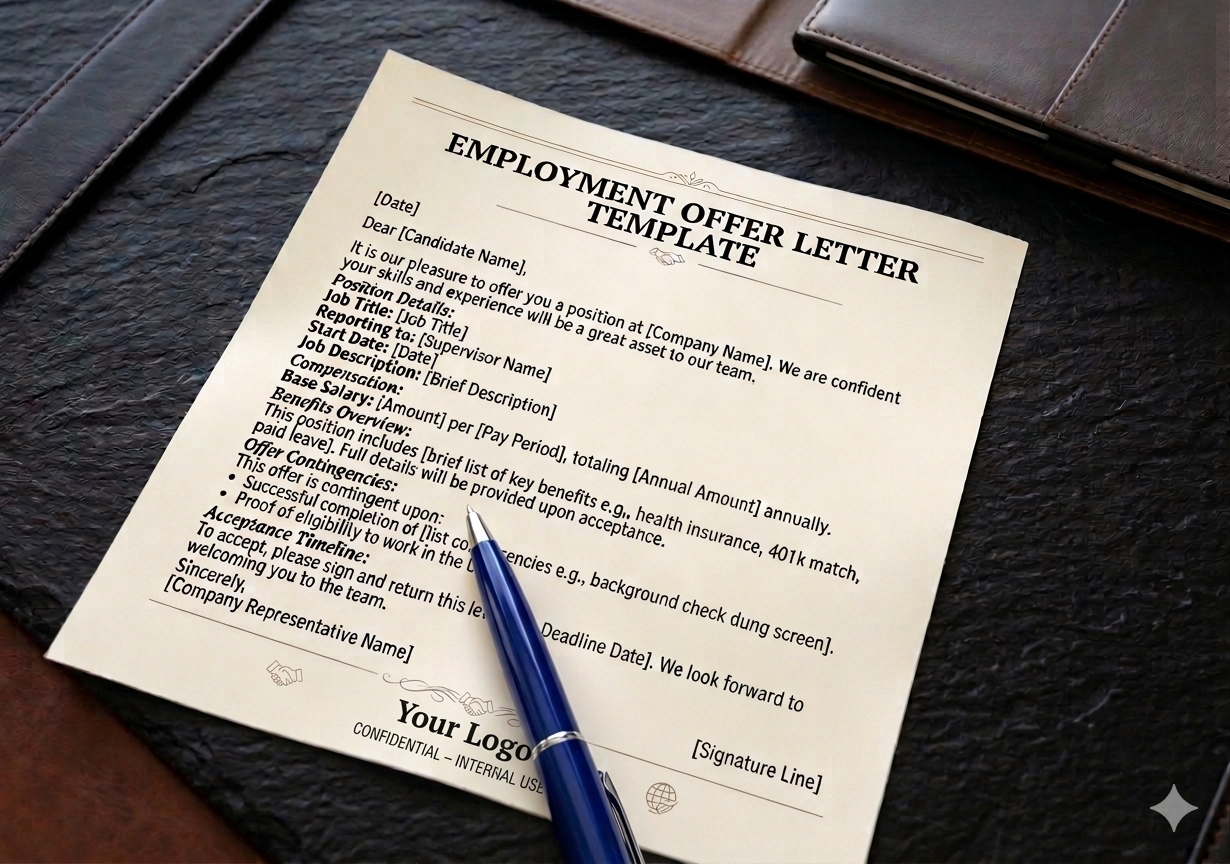
Offer Letter Template
This template can be used as a starting point for an offer letter for a full-time W-2 employee, with a few modifications included for part-time and temporary positions. Customize it to your company with additional details and your brand voice. Ensure that you display your branding in the tone, messaging, and formatting. It is recommended for clarity to use bullet points with key information. Have your offer letter template reviewed by your leadership team, human resources, and legal department.
Dear [candidate name],
Congratulations! We’re pleased to offer you the role of [full-time, part-time, or contract] position of [job title] with [Company name]. We’re excited to have you join our team. During our interview process, you impressed us with your [strengths]. Here are the key details:
- Department: [department or division name]
- Reporting to: [manager’s name, title, and contact information]
- Start date: [start date] [start time with time zone]
- End date: [Only include if the position is for a specified term. If so, include an end date or duration, eligibility to renew, and any consequences for early termination.]
- Schedule: [days] [times] [total of _ hours per week]
- Location: [work location and details]
- Compensation: [amount per pay period], paid [weekly, biweekly, semi-monthly, or monthly] by direct deposit or check
- Employment classification: [W-2 employee or 1099 contractor]
- Exempt or nonexempt: This is [an exempt or a nonexempt] position, and you [are or are not] eligible for overtime pay.
- Other compensation: [signing bonus, commissions, other bonuses, stock options, equity, stipends, and relocation expenses]
As [job title], you will be responsible for [expectations and responsibilities].
We offer a comprehensive benefits package. We’re especially proud to provide [desirable benefits and perks]. We believe you will enjoy our [highlight company attributes].
This is a conditional offer of employment, contingent upon successful completion of [a background check, reference checks, verification of eligibility to work in the United States, and _ ] as well as signing and complying with the following agreements: [specify agreements ex: employment contract and NDA].
This offer is not an employment contract and does not guarantee employment for any specific duration. This is an at-will employment relationship, which means that both you and [Company name] have the right to terminate your employment at any time, with or without cause or notice. This letter constitutes the final and complete agreement between the employer and the candidate.
If you have any questions or would like to discuss anything further, please contact [contact name] at [contact email and phone number].
Please sign below to indicate your agreement to the terms outlined in this letter by [expiration date].
We look forward to having you as a valued member of our team. We are eager to see what we can accomplish together. Congrats again on your new position!
Best regards,
[Company Rep Signature]
[Company Rep: Name, Title, and Date]
[Candidate Signature and Date Line]
[Candidate Printed Name]
 Latest resources
Take a look at our news on Human Resources
 by Sandra Robins
 by Sandra Robins
 by Sandra Robins
 by Sandra Robins

 by Nick Perry
 by Sandra Robins
 by Sandra Robins
 by Nick Perry
 by Sandra Robins
 by Sandra Robins
 by Sandra Robins
 by Sandra Robins