How to Track and Allocate Direct vs Indirect Costs

Written by
How to Track and Allocate Direct vs Indirect Costs Shanel Pouatcha
Updated

February 25, 2026

How to Track and Allocate Direct vs Indirect Costs
Caption icon Table of content

Few SMB owners actually consider costs in their pricing decisions. You know you have expenses, but do you really know which of these are direct, affecting every product and service you sell, and which are indirect and can be apportioned across your business?. In this article, we’ll take a closer look at the characteristics of these two cost types, how to categorize, track, and allocate them to gain a clearer understanding of your true profitability and make smarter business decisions.

Key Differences 

Understanding the differences between these two cost types is important for how you run your business:

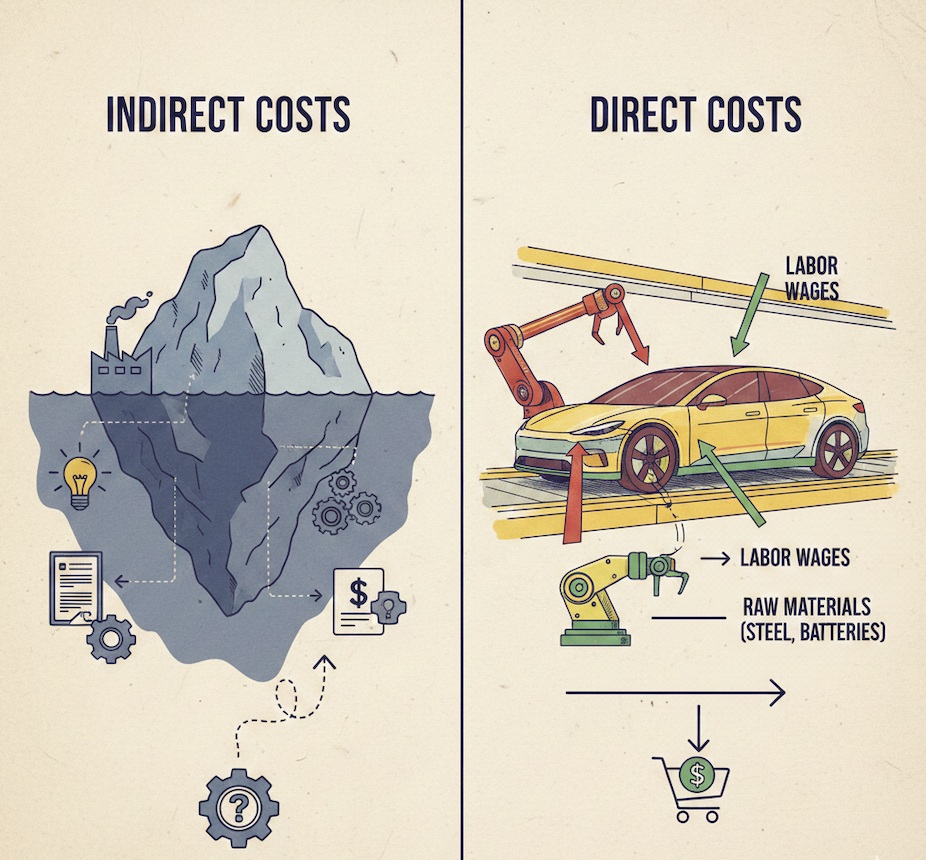
Traceability: Perhaps the most obvious difference is that direct costs can be easily linked to specific products or services while indirect costs support your entire business and are more difficult to allocate to individual items

Variability: Direct costs will vary based on production, while indirect costs are often fixed regardless of how much you make

Control: Direct costs are typically more controllable and can be reduced through efficiencies or material changes, while cutting indirect costs often requires operational changes

Understanding these distinctions can help you make better pricing and production efficiency decisions and choose whether or not to take an order. To learn more about this, explore our article on key differences between direct and indirect costs

Why This Matters 

Where most SMBs make their mistake is setting prices without considering overhead. If you’re a consultant and bill for $2,500 for a project that required $2,000 in direct labor costs, you might assume you’re making a $500 profit. But the reality is that you haven’t accounted for your office rent, software subscriptions, insurance, accounting help, or marketing expenses. Your profit might be $50, or it might be negative.

Small businesses that allocate both direct and indirect costs when pricing their offerings are much more likely to meet or exceed their profit goals. Failing to account for overhead is one of the leading reasons SMBs underestimate what they need to charge.

Calculating and Tracking Each Type 

The first step is to audit all your expenses. Make a list of every cost you have each month or year, then simply categorize each expense with this question: Is this directly tied to the production of my product or service? If yes, it’s a direct cost. If not, it’s an indirect cost. This exercise will give you a clear list of both direct and indirect expenses to track.

Tracking Direct Costs

Direct costs are the easiest since they have a one-to-one relationship with what you’re selling. Here’s how to handle them:

  • Track direct costs at the transaction level whenever possible. Don’t lump them together as a group—keep the information separate so you can see exactly where the money goes
  • Tag your accounting software expenses by product line, project, or service type to have clear visibility into what each offering costs to produce
  • Use a simple spreadsheet for a small business if you don’t have the accounting software, but plan to adopt software like QuickBooks or FreshBooks to keep your books when you scale

Now that you have a way to track direct costs, the next step is calculating them:

Direct Cost Per Unit = Total Direct Costs ÷ Number of Units Produced

Example: If you spent $500 on materials to produce 25 custom products, your direct cost per unit is $500 ÷ 25 = $20 per product.

Allocating Indirect Costs

You need to take a different approach to indirect costs since there is no one-to-one connection with products. You must allocate indirect costs across all your products and services using one of these formulas:

  • Per-unit allocation (most common): Total indirect costs ÷ total number of units (products sold, projects completed, service hours delivered)
  • Labor-hour allocation: Total indirect costs ÷ total labor hours worked
  • Revenue-based allocation: Allocate a % of revenue generated by each product

The most straightforward formula is:

Indirect Cost Per Unit = Total Annual Indirect Costs ÷ Total Annual Units Produced

Example: If total overhead for the year is $36,000 and you produced 1,000 units last year, the indirect cost per unit is $36,000 ÷ 1,000 = $36 per unit. Each unit must cover $36 of overhead.

Common Mistakes 

Owners frequently make several costly errors when classifying and allocating their business expenses that lead to underpricing, inaccurate financial projections, and ultimately lower profit margins than expected. These mistakes are especially common in the first few years of business while owners are multitasking and learning on the fly. Identifying these missteps in advance can help you avoid wasting money on these missteps and make better business decisions in the future.

Underestimating Indirect Costs

One of the most prevalent mistakes is underestimating overhead costs, especially in the early years when many businesses are running from home or out of a shared office space. Many owners think they don’t have indirect costs because they don’t have a separate office. This is dangerous thinking that can significantly distort true profitability.

Your internet, phone bill, a portion of your home and mortgage, professional development costs, software subscriptions, and accounting services all count as indirect costs, even if they don’t seem like “real” expenses. When you don’t include these in your pricing, it’s like giving your profit away for free without even realizing it.

Misallocating Overhead Across Products

Another mistake many owners make is spreading indirect costs across their various product lines and services equally. This feels fair and simple, but it’s rarely an accurate reflection of the real business. A more labor-intensive product that requires more materials handling and customer support deserves a higher share of labor-related overhead than a low-touch offering.

If you sell both high-touch consulting services and self-serve digital products, allocating the same overhead amount to each is a recipe for mispricing one or both of these offerings. Take the time to allocate indirect costs more accurately based on what actually drives those expenses, and you’ll gain much clearer insight into which products are truly profitable.

Forgetting About Hidden Direct Costs

Owners also sometimes fail to account for direct costs that aren’t immediately obvious. Service providers, for example, often forget to include time spent on customer communication, revisions, and project management as a direct cost of delivering that service. If you sell physical products, you may forget to include packaging, shipping, payment processing fees, and handling returns. Some owners also don’t account for the time they spend recruiting, training, and managing contractors or employees who work on specific projects. These hidden direct costs add up quickly and can transform what looked like a profitable service into a loss leader.