Choosing the Right Business Entity for Your Venture

March 12, 2026

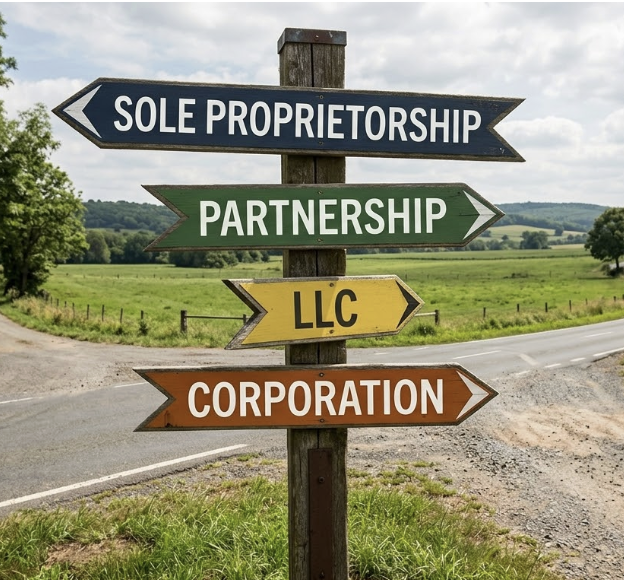
Selecting between business entities is one of the most consequential decisions entrepreneurs make. The structure you choose affects everything from personal liability exposure to how much you pay in taxes each year. Understanding the main entity types available in the United States—and the jurisdictions that offer the most favorable terms—positions business owners to make informed decisions that serve their long-term interests.
Sole Proprietorship
There is no paperwork or specific process to create a sole proprietorship. Simply put, if you operate a business as yourself and haven’t incorporated or formed an LLC you are a sole proprietor. The owner of a sole proprietorship has unlimited control of the business.
Tax Implications
The downside of a sole proprietorship is that there is no liability protection. If your business gets sued your personal assets like your home can be taken to satisfy the judgment. Because of this sole proprietorships only really make sense if your low risk venture or are a freelancer looking to try out a business idea.
Tax-wise things are pretty simple for sole proprietors. You report all of your business income on Schedule C which then attaches to your personal tax return. You are also taxed 15.3 percent of net income for Social Security and Medicare taxes. Eligible owners can deduct up to 20 percent of their qualified business income.
Partnership
A partnership is a formal arrangement by which two or more people co-own a business. General partnerships divide control equally among the partners. In contrast, limited partnerships have both general partners and limited partners. Limited partners only risk losing their investment in the business.
Tax Implications
Partnerships can divide profits however they’d like through the partnership agreement. Like sole proprietorships, general partners of a partnership are personally liable for the partnership’s debts. For tax purposes, partnerships get pass-through taxation as well. That means the partnership itself doesn’t pay federal taxes. Instead, each partner receives a Schedule K-1 which outlines their portion of profits and losses. Each partner will then use this form on their individual tax returns.
Limited Liability Company (“LLC”)
An LLC is a hybrid entity that offers its owners protection from personal liability while being taxed like a partnership. LLC owners are referred to as members. An LLC can be managed by members or by managers. There is no maximum limit on members and they can consist of individuals, corporations, foreign entities, and more. LLCs can operate almost anywhere and have very few company formalities.
Tax Implications
LLC can file paperwork to be taxed as an S corporation or a C corporation.
Corporation
A corporation is a person separate and distinct from the people who own it. Corporate structures support an unlimited number of shareholders and allow for perpetual existence. Corporations can also issue stock which allows them to raise capital from investors.
Tax Implications
With corporations come Limited Liability. Owners of corporations are generally not held personally liable for business debts. However, this comes at a price. Because shareholders don’t pay taxes on corporate profits directly, corporations get taxed twice. First the corporation gets taxed on its income at the corporate tax rate (21 percent in 2018). The profits get taxed again when distributed to shareholders as dividends. Despite its drawbacks, incorporating offers fringe benefits deductions, allows owners to pay lower taxes on retained earnings, and can give your business more credibility.
C corporations file form 1120 and pay taxes at a flat rate of 21 percent. Shareholders then pay taxes on qualified dividends when receiving distributions (0 percent – 20 percent). S corporations pay no federal taxes. Instead, all of the income is passed through to the shareholders and reported on their individual tax returns. However, the owners of S corps still must pay themselves a “reasonable salary” which is taxed as normal wages.
Where to Incorporate
Just as important as your entity type is where you decide to incorporate your business. Each state has different rules regarding taxation, annual fees, and more. Here are a few of our favorite states to form your business:
Delaware
Called The First State for a reason, Delaware has been setting the standard for corporations for over 100 years. Delaware is home to the Court of Chancery. This court only hears business related cases, allowing it to become extremely efficient and well versed in business law. Incorporating in Delaware deters litigation because potential litigants know the court will not be sympathetic to inexperienced businessmen. Over 66.7 percent of Fortune 500 companies are incorporated in Delaware. Although Delaware does not tax businesses based on revenue earned outside of the state, it does impose a franchise tax measured by the number of authorized shares.
Wyoming
Wyoming was the first state to allow LLCs and offers many features that rival Delaware. Wyoming doesn’t have a state income tax. It also has no franchise tax. Like Delaware, Wyoming offers incredible privacy for business owners. Unlike any other state, only the LLC member’s taxed mailing address will be publicly available. For real estate investors, Wyoming has passed legislation that offers invaluable protection against creditors. When an LLC is sued in Wyoming the plaintiff can only obtain a charging order against distributions. If the LLC doesn’t distribute profits then the plaintiff gets nothing.
Nevada
Nevada is another state with strong privacy laws. If formed in Nevada neither the company’s information nor the owners will be listed on any public.registry. Nevada offers the same protection as Wyoming regarding piercing the veil. There is no state income tax or franchise tax in Nevada. Starting an LLC in Nevada costs $100 and the annual report is only $60. Be mindful that Nevada does have a Commerce Tax for businesses with greater than $4 million in Nevada gross revenue.
South Dakota
South Dakota has been ranked number one for estate planning trusts for 14 years straight. Known as dynasty trusts, South Dakota allows trusts to last indefinitely. The state also offers no state income tax and has the best privacy laws in the country. When forming a trust in South Dakota, unlike any other state, the court records will be sealed permanently.

Take a look at our news on Business Essentials

by Shanel Pouatcha

by Nick Perry

by Nick Perry

by Shanel Pouatcha

by Shanel Pouatcha

by Nick Perry

by Nick Perry

by Shanel Pouatcha

by Nick Perry

by Nick Perry

by Nick Perry

by Nick Perry